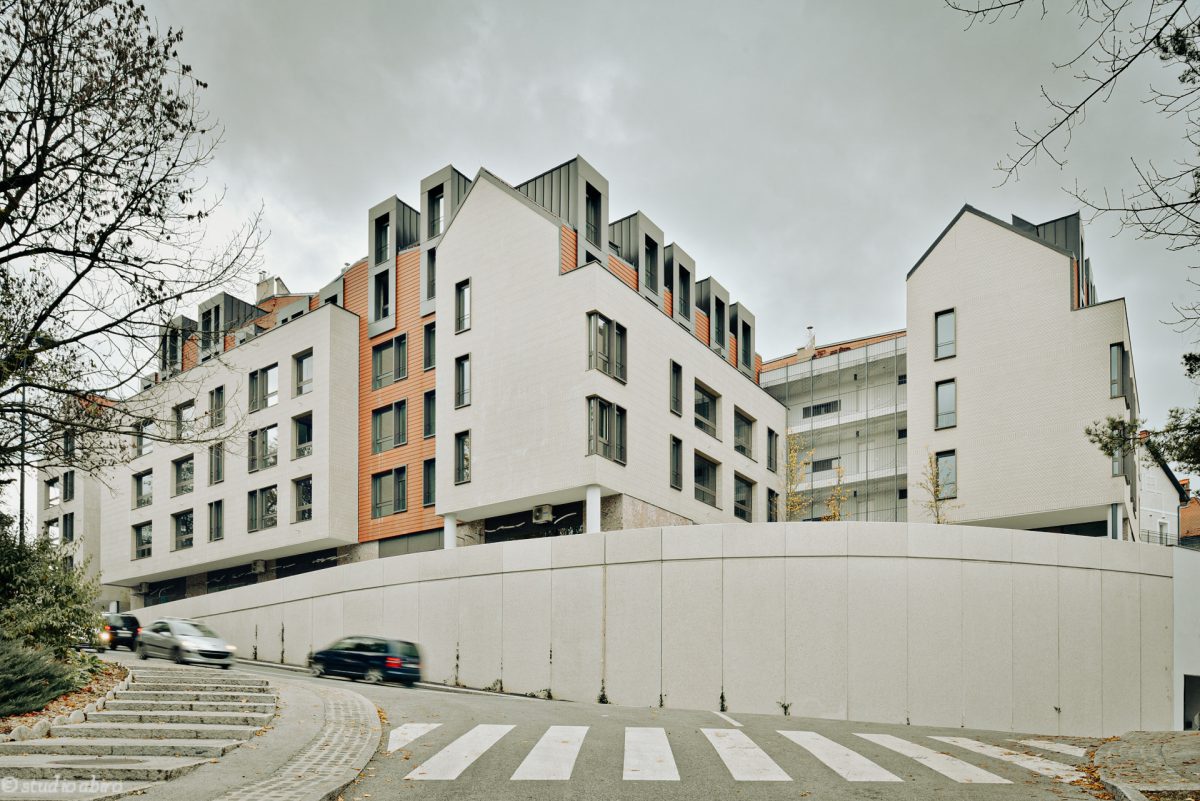
The key to the success of the spatial interpolation into the historic city centre is its thoughtful design of the building body.
The prominent corner position at the western entrance to the old town centre of Kranj was dominated for decades by the Hotel Jelen, the most representative hotel in Kranj before the Second World War. The accommodation was complemented by a well-attended restaurant. The building, with its early modernist features, was active through better and worse periods until the 1970s, when the famous Hotel Creina was built nearby. With the expansion of the hotel offer in Kranj, and later as a result of a change of ownership in the 1990s, the hotel closed its doors in 1995 due to obsolescence. Homeless people moved in, and the unmaintained building in an eminent location offered many opportunities for crime. The hotel area lies at the crossroads of modern and medieval Kranj, and its location is also highlighted by the viewpoints of nearby Šmarjetna Gora. The former furman’s hotel stables were added to the medieval city walls. Even if the hotel was not built within the walls, its location on the edge of the unified cliff of the old town made it inextricably linked to it.
The design of the new apartment building with a publicly accessible ground floor involved intensive coordination with the conservation authorities to define an urban form that would be appropriate to the new residential content, but morphologically related to the fabric of the city centre. The development is divided into two buildings, between which the bell tower of Kranj Cathedral is overlooked from the main town square. The smaller building is compact, with the flats organised around a central corridor, while the larger building is divided into two parallel bays around a central open courtyard. The courtyard opens onto an internal “porch” which gives access to all apartments. Morphologically, the design is based on the type of medieval house with an inner courtyard opening onto service and ancillary spaces. In two places, the gable opens outwards, towards modern and medieval Kranj.
The floor plan, fully adapted to the housing programme, is contextualised by a broken and varied roof contour. It optically further fragments the building array, which is particularly pronounced in relation to the roof image of the old town. The façade is clad in grey ceramics, laid in a textile ‘fishbone’ pattern, emphasising its Semperian non-tectonic character.
Particular attention was paid to the design of window and balcony openings. Modern dwellings are lit by large, predominantly horizontal or square-shaped openings, which are in stark contrast to the rhythm and vertical proportions of a classical medieval or historic façade. Through the repetitive design of the three types of openings, which exploit the contrast between the accentuated vertical and the hidden horizontal form, a subtle dialogue is established between the contemporary content and the traditional context.
The Jelen apartment building comprises 66 apartments and 6 service premises on the ground floor, including a newly planned restaurant with a summer garden. The key to the success of the spatial interpolation into the historic city centre is its thoughtful design of the building body. The building does not disintegrate into a series of tiny houses, but retains its appearance and integrity, but carefully relates to its context in its floor plan and cross-section.
Authors of the project: BLENKUŠ Matej, FLORIJANČIČ Miloš
| Static: | Berce Anton |
| Other engineers: | Poljšak Miran, Robič Andrej, Lisec Mitja |
| Implementation: | Lesnina Engineering, d.d. |
| Project year: | 2010 |
| Year of implementation: | 2013 |
| Photo / visualisation: | Kambič Miran |
| Customer: | Elektroservisi, d.d. |
| Awards / publications: | Architecture Inventura 2012 – 2014, exhibition of the Association of Ljubljana Architects, participation in the national exhibition, Association of Ljubljana Architects, Great Reception Hall, Cankarjev dom, Ljubljana, January, 2015 Nomination for the Plečnik Award 2014, National Award, Fund by architect Jože Plečnik, 14.05.2014 Article Residential and Business Complex Dvorec Jelen, Kranj, published in the local publication, Why We Need an Architecture Act and a Development Competition Programme for Residential Construction, Ajax studio, Ljubljana, author of the article and publication Viktor Pust, p. 102 – 103, 2013 Publication Plečnik’s Awards 2014 : Dessa Gallery, publication in a local publication, pp. 31, April 2014 Publication Architecture Inventura 2012 – 2104, retrospective exhibition by members of the Ljubljana Association of Architects, publication in a local publication, pp. 73, January, 2015 Article Jelen Manor – an architectural excess, published in a local publication, Elegra Magazine, # 13, Elektroservsisi, d.d., author of the article Brane Ribič, pp. 4 – 9, May, 2013 |

