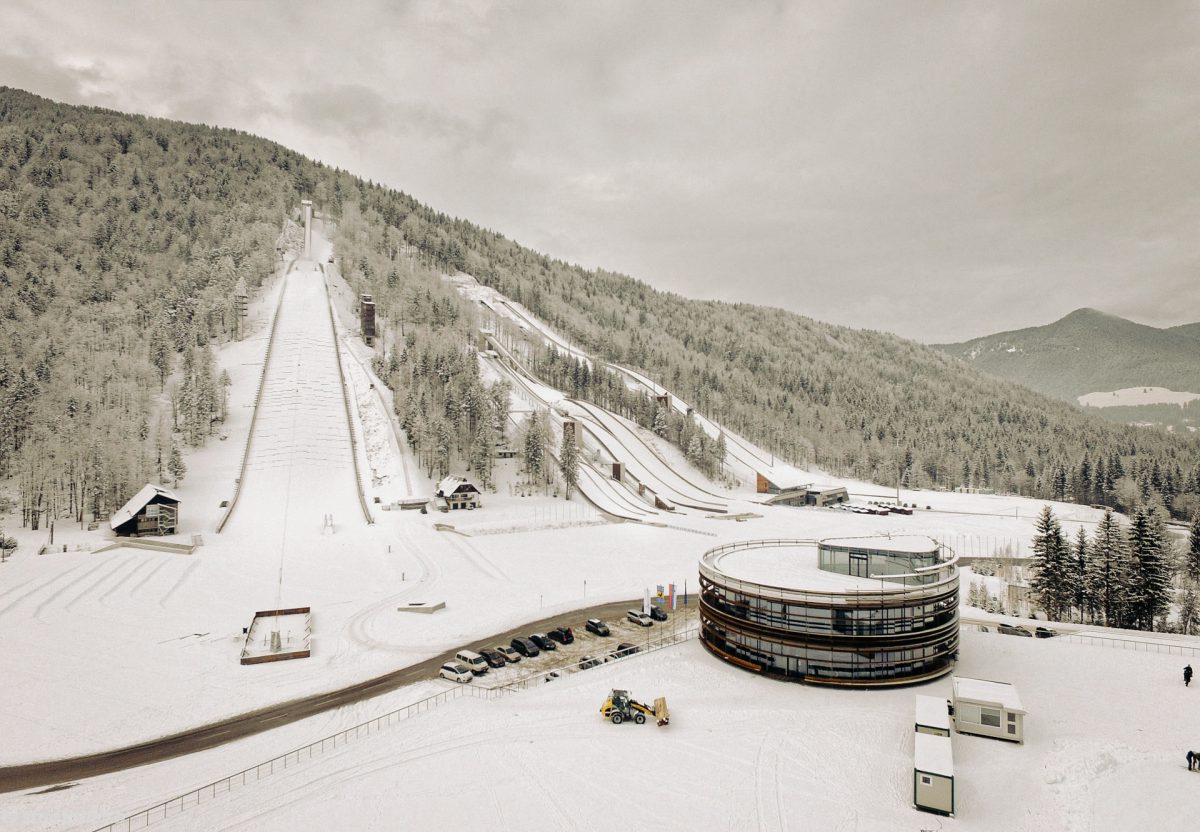
All components of the flying hll are designed in such a way that they can be extended to allow even longer flights, subject to the agreement of the international federation.
The Goriška brothers’ aerodrome is often referred to, albeit erroneously, as “the giant of the mountains”. The flying hill is certainly one of the largest in the world, and after the renovation of most of them, these specific sports facilities are practically indistinguishable from each other. The FIS International Ski Federation’s homologation procedures for renovated facilities aim to standardise the sporting conditions at all facilities and to ensure equal opportunities for record-breaking flights, regardless of location.
During the refurbishment of the aerodrome, the profile of the building was partially redesigned, both on the runway and on the apron. A completely new runway has been built, with a bridge bridge added to bring the visitor-accessible viewpoint into line with the conditions and views that athletes are normally faced with just before their jump. The top of the slipway is designed as a dual-purpose slipway and can be used to attach the top station of a zip-line “skating rink” during the summer. This brings the experience of jumping out of an aerodrome even closer to visitors.
Unlike the other sports facilities of the Nordic Centre, which are available for training and competitions all year round, the aerodrome is only used for sports activities for three days a year, during the annual World Cup Flying Finals. The rest of the time the object is stationary, which makes its hybrid role all the more important. Since the aerodrome symbolises Planica as a whole, but is rarely used by athletes, its design has also taken the architectural and design starting points that were already present in the two previous phases and brought them closer to visitors of the Nordic Centre by making them accessible to key spaces and experiences.
Both the apex of the runway and the profile at the end of the runway are designed in such a way that, with the agreement of the International Federation, they can be extended to allow even longer flights.
Another special feature of the design is the running track, where a large part of the existing steel structure of the railings and stairs was reused during the renovation, i.e. relocated to a new location while correcting the terrain of the running track. Unlike other ski jumping hills, where the profiles of the individual jumping facilities are definitive according to the sporting profession, aerodromes are facilities where the sport is developed and modernised. As a result, it makes sense and logic that the aerodrome layouts are designed to be more flexible and can be recycled for future improvements and upgrades.
The Goriška Brothers Airport is located on the southernmost edge of the centre, at the border with the Triglav National Park. It is the largest and most imposing structure in Planica, but unlike the other ski jumps, its architectural expression is more pragmatic and even simpler.
Authors of the project: BLENKUŠ Matej, FLORIJANČIČ Miloš, KUČAN Ana, JAVORNIK Luka
| Static: | Kilar Vojko |
| Other engineers: | Poljšak Miran, Robič Andre |
| Implementation: | Public Lighting, d.o.o. |
| Project year: | 2013 |
| Year of implementation: | 2014 – 2018 |
| Photo / visualisation: | Kambič Miran |
| Customer: | Sport Institute of the Republic of Slovenia Planica |

